BASIC JIUJITSU KNOWLEDGE
Your quick guide to what Jiu-Jitsu is, how it’s different from other martial arts, and how progress works.
HISTORY OF JIUJITSU
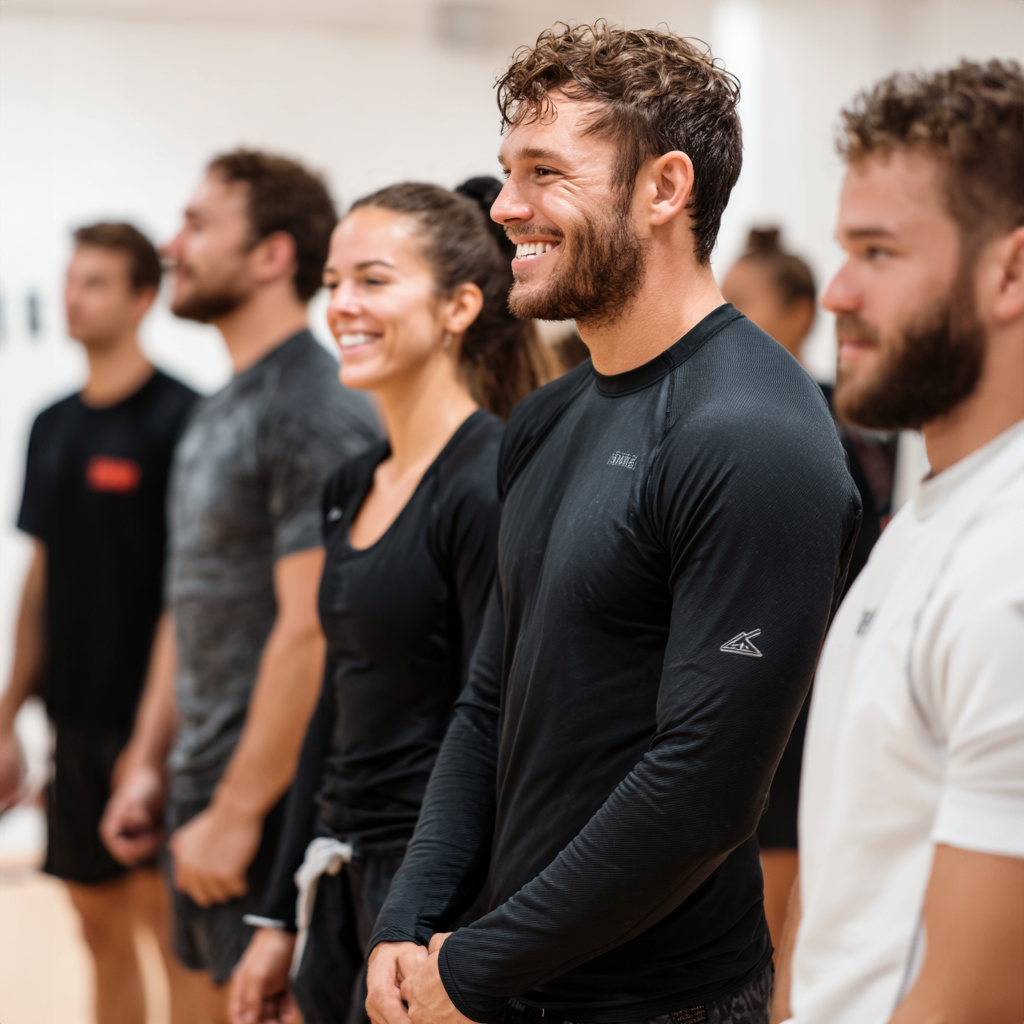
Jiu-Jitsu began as part of the Samurai’s skill set in Japan. If a Samurai lost their sword, they needed a way to control or defeat an armored opponent without strikes — because punches and kicks didn’t work against armor. Instead, they used off-balancing, trips, throws, and holds to control someone or take them down. This was called Japanese Jiu-Jitsu.
In the early 1900s, the art was introduced to Brazil, where it evolved into Brazilian Jiu-Jitsu (BJJ). The focus shifted more toward ground fighting — using the floor as a tool for control. This version allowed smaller people to use leverage, positioning, and technique to control and defeat larger opponents, even from their back with the use of submission holds (joint locks or strangle holds) that would incapacitate their opponents. The family that popularized BJJ was the Gracie Family, lead by Carlos and Helio Gracie, arguably the most popular sports family in the world, with many of their sons competing and teaching all over the world.
The popularity of Jiu-Jitsu exploded in the 1990s with the rise of the UFC (Ultimate Fighting Championship). In the very first UFC event, Royce Gracie, a smaller Jiu-Jitsu black belt, defeated multiple larger opponents from different martial arts styles — proving that technique and grappling could overcome size and striking. This was the moment that introduced the power of Jiu-Jitsu to the world and kickstarted the modern MMA (Mixed Martial Arts) movement.
Today, Brazilian Jiu-Jitsu is practiced worldwide — for sport, self-defense, fitness, and as a lifelong discipline of problem-solving and learning.
MARTIAL ARTS DIFFERENCE
Jiu-Jitsu stands apart from most martial arts because of its focus on grappling and submission holds, rather than strikes like punching or kicking. While striking arts like boxing, kickboxing, karate, or taekwondo focus on punches and kicks, Jiu-Jitsu has zero strikes.
Even compared to other grappling arts — like wrestling and judo — Jiu-Jitsu is different in how matches are decided. Wrestling and Judo are focused on takedowns and pins. The goal is either to throw your opponent (in judo) or hold them on their back (in wrestling) for a certain amount of time. Jiu-Jitsu starts similarly — with grips, takedowns, and body control — but instead of the goal being a pin, the match continues on the ground. The focus shifts to passing their defenses (like their legs and arms), controlling their body, and applying submission holds like a choke or joint lock. There are tournaments that will count takedowns and pins as points to help decide a winner if there are no submissions.
The main safety mechanism that allows Jiu-Jitsu to be trained often is called “tapping out” (meaning patting their partner twice, or saying the word ‘Tap’). This signals if the submission hold were to continue, damage would have taken place or passing out. In a real fight, both of these would be a huge disadvantage now. In sport and training, this mechanism allows practitioners to train at 100% effort, against a fully resisting opponent, without injury — because the tap stops the fight before damage happens. That’s something very few martial arts can offer, especially those based on striking.
JIUJITSU STYLES
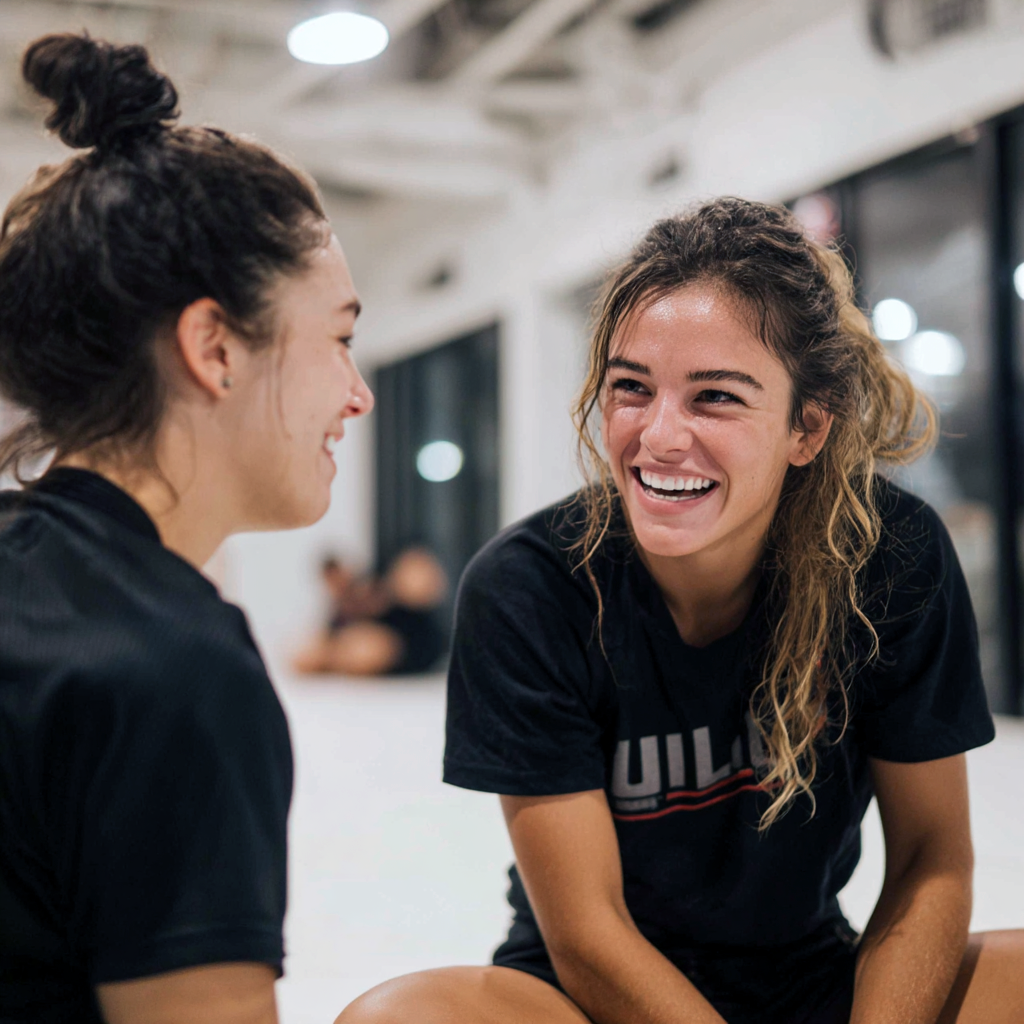
Jiu-Jitsu has two main styles that both teach the same core skills of control, positioning, and submissions — but they feel a little different in how they’re practiced:
Gi Jiu-Jitsu (Brazilian Jiu-Jitsu): Practiced wearing a traditional kimono-style jacket called a Gi. The Gi allows for grips on the sleeves, collars, and pants. This also creates an opportunity to use the jacket for submission holds as well, including strangulation with the jacket.
NoGi Jiu-Jitsu (Submission Grappling): Often practiced in shorts and a rash guard. Without clothing grips, it relies more utilizing body mechanics to nullify their partner since there are minimum grips.
Both styles teach the same phases of Jiu-Jitsu — how to connect, advance, control, and submit — but with different tools and slightly different pacing. Gyms around the world generally practice both, with some having main focuses on one style over the other.
Even though Japanese Jiu-Jitsu was the first iteration of Jiu-Jitsu, there are not many practitioners of the art these days. For making terminology easier, we refer to Jiu-Jitsu as the umbrella term for the art, followed by Brazilian Jiu-Jitsu (BJJ) referring to Jiu-Jitsu practice with the Gi Kimono, and Submission Grappling (often referred to as NoGi) as the practice without the jacket.
JIUJITSU BELT RANKS
The belt system comes from early martial arts uniforms, where a simple white belt was used to tie the jacket (often a kimono). Over time, that white belt would darken from use — sweat, dirt, and years of training — symbolizing experience. This idea inspired the modern belt system, moving from white to black as a sign of progression.
In Jiu-Jitsu, the belt colors represent clear stages of skill:
White — Beginner
Blue & Purple — Intermediate
Brown & Black — Advanced
Higher ranks like Red Belt exist but are honorary, recognizing a lifetime of contribution to the art.
To show progress between belt promotions, most gyms use a stripe system — a black bar on the belt where stripes (white tape) are added over time. Earning four stripes usually means you’re approaching the next belt rank. This matters because belts can take 1-2 years (or more) each to earn.
In Gi Jiu-Jitsu, the belt is part of the uniform, used to tie the jacket. In NoGi Jiu-Jitsu, belts aren’t worn while training, but ranks are still awarded through the same belt and stripe system as a symbol of skill and dedication.
THE FIVE TYPES OF SUBMISSIONS
Submissions are the finishing moves of Jiu-Jitsu —
a way to safely control someone until they have no choice but to tap out.
While there are endless variations, nearly every submission falls into one of five core types...
HEAD CHOKES
Submissions that control the neck using your arms alone.
These focus on wrapping around the opponent’s neck with your arms, compressing the carotid arteries to cause a blood choke (with the technical term being a strangulation).
Common Head Lock Choke Types:
Rear Naked Choke
Just wear comfortable workout clothes — shorts, leggings, or joggers and a t-shirt or rashguard. We train No-Gi, so no special uniform is needed.
Guillotine Choke
Accordion Content
North South Choke
Accordion Content
TRIANGLE CHOKES
Submissions that use a triangle-shaped frame to choke the neck — with either your arms or legs.
These submissions trap the opponent’s neck and one arm, using pressure on both sides of the neck (their own shoulder on one side and your limb on the other). The triangle shape creates an extremely effective blood choke.
Common Triangle Choke Types:
Front Triangle (Legs)
Just wear comfortable workout clothes — shorts, leggings, or joggers and a t-shirt or rashguard. We train No-Gi, so no special uniform is needed.
Arm Triangle (Mount)
Accordion Content
D'Arce Choke
Accordion Content
Anaconda Choke
Accordion Content
ARM LOCKS
Submissions focused on hyperextending the elbow joint.
These submissions trap the opponent’s arm and apply pressure against the elbow joint by extending it beyond its safe range of motion. They are powerful, fast, and can be set up from many positions.
All arm locks are based on the concept of isolating the arm, controlling the wrist and elbow line, and applying force through the hips or body to straighten the joint beyond its limit.
Common Types of Arm Locks:
Straight Arm Lock
Just wear comfortable workout clothes — shorts, leggings, or joggers and a t-shirt or rashguard. We train No-Gi, so no special uniform is needed.
Belly Down Arm Lock
Accordion Content
SHOULDER LOCKS
Submissions that rotate or isolate the shoulder joint.
These attacks force the shoulder to twist beyond its safe range, threatening a tear or dislocation.
Shoulder locks often involve a figure-four grip on the opponent’s arm.
Common Types of Shoulder Locks:
Americana
Just wear comfortable workout clothes — shorts, leggings, or joggers and a t-shirt or rashguard. We train No-Gi, so no special uniform is needed.
Kimura
Awesome — we’ll meet you at your level. We love helping returning grapplers refine their fundamentals and rediscover their rhythm.
Omoplata
Accordion Content
Tarikoplata
Accordion Content
LEG LOCKS
Submissions targeting the legs, knees, and ankles.
These submissions control the lower body, attacking either the knee (through rotational or hyperextension pressure) or the ankle joint.
Leg locks have become extremely important in modern Jiu-Jitsu and submission grappling.
Common Types of Leg Locks:
Ankle Lock
Just wear comfortable workout clothes — shorts, leggings, or joggers and a t-shirt or rashguard. We train No-Gi, so no special uniform is needed.
Toe Hold
Accordion Content
Knee Bar
Accordion Content
Heel Hook
Accordion Content
Calf Slicer
Accordion Content
THE FOUR MAIN GRAPPLING SITUATIONS
“Every grappling exchange happens within one of four main situations. Whether you are standing, seated, or on the ground, the goal is to connect, manage distance, control space, and apply the right strategies for the position. Each of these situations has common patterns that show up again and again — learning to recognize them is the first step to learning how Jiu-Jitsu flows.”
STANDING
Standing is the starting point for most grappling exchanges. It’s where both people are upright, trying to connect to each other safely. The goal is to use grips, body control, and balance to decide how the exchange will move to the ground. This can be done by grabbing the head, body, arms, or legs in a way that creates control and leads to takedowns or transitions.
Inside Ties
Your Body: You are standing close with your hands on the inside of their arms or shoulders. Your head is close to theirs.
Their Body: They are also standing, trying to get their hands in good spots or move around you.
Goal: Use your hands and head to stay close, control where they move, and look for ways to grab better or move to something stronger like a body lock or leg grab.
Body Lock
Your Body: Your arms are wrapped all the way around their body, hugging their waist or just under their arms. Your chest is close to their chest or side.
Their Body: They are standing and trying to push you away, stay balanced, or break your hug.
Goal: Hold their body tight so they can’t move away. You can use this to tip them over, lift them, or trip them.
Headlock (Front Head Control)
Your Body: You are bent over a little with your arm wrapped around their head and maybe one arm. Your head is close to their back or side.
Their Body: They are bent over too, with their head under your arm, trying to stand up, pull away, or grab your legs.
Goal: Keep their head and upper body low and under control. You can use this to push them down, spin around to their back, or go for chokes.
Single Leg (Leg Grab)
Your Body: You are holding one of their legs with both of your arms. Your head is close to their body on one side.
Their Body: They are standing on one leg while you hold the other. They are trying to stay standing or push you away.
Goal: Hold their leg tight so they can’t pull it away. You can try to trip them, push them, or lift the leg to make them fall.
Double Leg (Both Legs Grab)
Your Body: You are bent down holding both of their legs with your arms wrapped behind their knees. Your head is close to their belly or side.
Their Body: They are trying to stay standing while you grab both legs.
Goal: Hold their legs and drive forward or lift to bring them down to the ground.
Collar Tie / Snap Down Position
Your Body: One hand is holding the back of their head or neck, and the other can be grabbing their arm or wrist. Your head is close to theirs.
Their Body: They are standing close, trying to stay strong or pull your hand off.
Goal: Use the hand on the head to pull their head down, move them, or set up a better grip or a move to the legs or body.
GUARD
The guard is when one person is on the bottom using their legs as a shield and control system. Your legs frame against the other person’s hips, thighs, or torso to keep them from passing and to set up attacks. Whether closed, open, or seated, the guard helps manage distance, off-balance the opponent, and create submissions or sweeps to get on top.
Open Guard
Your Body: You are laying on your back or sitting up with your legs not locked but out in front of you. Your feet touch their legs, hips, or shoulders to keep space or connect.
Their Body: They are standing or kneeling in front of you, trying to get past your legs.
Goal: Use your feet and hands to keep them away, stop them from getting close, and look for ways to move them or attack.
Closed Guard
Your Body: You are laying on your back with your legs wrapped all the way around their waist. Your feet are locked together behind their back.
Their Body: They are sitting or kneeling between your legs, trying to stay tall or open your legs.
Goal: Use your legs and arms to hold them close, stop them from standing up or moving away, and look for ways to turn them over or go for submissions.
Seated Open Guard (Butterfly Guard)
Your Body: You are sitting up with both of your feet inside their legs, like hooks on their inner thighs. Your hands can grab their arms, head, or body.
Their Body: They are kneeling or standing in front of you.
Goal: Use your feet like little hooks to tip them over or pull yourself under them for sweeps or submissions.
Supine Closed Guards
Your Body: You are laying on your back with both feet up in the air, pointing toward them. Your legs are like long arms trying to touch their hips, legs, or shoulders.
Their Body: They are standing in front of you.
Goal: Use your legs to stop them from getting close and look for ways to pull yourself under them, trip them, or make them fall down.
Half Guard
Your Body: You are laying on your side or back with one of your legs wrapped around one of their legs. Your other leg is free to help push or frame.
Their Body: They are on top of you, trying to move past your leg to get to mount or side control.
Goal: Keep control of their leg, stay close, and use your arms and free leg to move yourself to a better spot or tip them over.
UPPER BODY PINS
Upper body pins are about holding someone down by controlling their torso, shoulders, and hips with your body. This happens when you pass their legs and secure positions like side control, mount, or turtle. You use your chest, hips, knees, and arms to stay heavy, limit their movement, and create chances to submit or transition to even stronger control.
Side Control
Your Body: You lay on top of their belly, sideways like a T shape. One knee near their belly and one by their head.
Their Body: They are laying flat on their back.
Goal: Keep them from rolling away or getting up. You hold them still with your arms and body.
North-South
Your Body: You lay on top of them, but your head is by their belly and your hips are by their head.
Their Body: They are laying flat with their head under your belly.
Goal: Hold their chest and belly so they can’t move. You can move to other spots or hold their arms.
Turtle
Your Body: You are on top of them while they are like a turtle on hands and knees. Your knees are close to their sides.
Their Body: They are on hands and knees trying to hide or protect.
Goal: Keep them from standing up or rolling. You can try to get on their back or hold their arms.
Knee on Belly
Your Body: One knee is on their belly and the other foot is on the floor to help you balance.
Their Body: They are laying flat and trying to move away.
Goal: Keep them down while you sit on them with your knee. You can move to other spots if you want.
Mount
Your Body: You sit on their hips or chest with your knees by their sides.
Their Body: They are laying flat on their back.
Goal: You stay on top, hold them down, and maybe look for ways to hug an arm or neck.
Rear Mount
Your Body: You are laying on top of their back with your chest on their back. Your legs are hooked around their legs or hips like a seatbelt.
Their Body: They are laying flat on their belly with their face down.
Goal: Keep them from crawling forward or getting up. You use your arms and legs to hold them tight and try to look for ways to control their arms or n
Back Control
Your Body: You are sitting behind them with your chest on their back. Your legs are wrapped around their hips or locked in a body triangle.
Their Body: They are laying on their back, belly up, but you are still behind them with your chest on their back.
Goal: Hold them tight so they cannot turn or get away. You can look to hug around their neck or arms to stay in control and try for submissions.
LOWER BODY PINS
Lower body pins are when you control the opponent’s legs and hips using leg entanglements. Your legs wrap around one or both of their legs in ways that trap their movement and set up submissions like heel hooks, knee bars, or ankle locks. The position of your legs relative to their leg—whether inside or outside their hip line—determines the type of control and attack options available.
Straight Ashi (Single Leg X / Straight Ashi)
→ The foundational leg entanglement where one leg wraps around the opponent’s leg with your feet controlling hips or knees. Primary control for ankle locks.
Outside Ashi
Variation where your entangling leg stays on the outside of the opponent’s hip line. Offers control for knee bars and ankle locks.
50/50 (Cross Outside Ashi)
Accordion Content
411 (Cross Inside Ashi)
Accordion Content
THE THREE MAIN THEMES IN JIUJITSU
The main goal of Jiu-Jitsu is as simple as this: you are looking for ways to get past frames to access their hips/torso, and then attack those frames.
INFILTRATE
The Art of Surviving
Build the instincts and skills to manage distance, de-escalate threats, and survive the unexpected. SHIELD training focuses on real-world scenarios including punch protection, escaping holds, and safely disengaging.
What You’ll Learn:
Punch defense & clinch survival
Escapes from pins & chokes
Standing & De-escalation Strategies
Women’s-specific scenarios
Level completion via situational testing
Who It’s For:
Those looking for practical, real-world self-defense that emphasizes control, composure, and safety — not aggression.
ISOLATE
The Tactics of Control
Sometimes, survival isn’t enough — you need to take control. SWORD is about offensive grappling in real-world contexts: pinning, takedowns, and safely neutralizing a threat.
What You’ll Learn:
Top control positions (mount, side, back)
Standing clinch and takedown entries
Limb isolation and pins
Dominating untrained attackers
Performance-based rank advancement
Who It’s For:
Those seeking decisive control in combative settings — whether for professional use, martial preparedness, or personal growth.
FINALIZE
The Game of Grappling
What happens when both people know what you know? SPORT training explores Jiu-Jitsu as a live, ever-evolving strategy game. Learn how to win through timing, precision, and adaptation.
What You’ll Learn:
Guard passing & retention
Live rolling & sparring strategy
Submission chaining & defenses
Grip fighting & point systems
Performance-based rank advancement
Who It’s For:
Those driven by mastery, strategic depth, or the thrill of competing — or anyone who wants to explore Jiu-Jitsu as a lifelong art.
THE TWO MAIN JIUJITSU CYCLES
The main goal of Jiu-Jitsu is as simple as this: you are looking for ways to get past frames to access their hips/torso, and then attack those frames.
OFFENSE
The Art of Surviving
Build the instincts and skills to manage distance, de-escalate threats, and survive the unexpected. SHIELD training focuses on real-world scenarios including punch protection, escaping holds, and safely disengaging.
What You’ll Learn:
Punch defense & clinch survival
Escapes from pins & chokes
Standing & De-escalation Strategies
Women’s-specific scenarios
Level completion via situational testing
Who It’s For:
Those looking for practical, real-world self-defense that emphasizes control, composure, and safety — not aggression.
DEFENSE
The Tactics of Control
Sometimes, survival isn’t enough — you need to take control. SWORD is about offensive grappling in real-world contexts: pinning, takedowns, and safely neutralizing a threat.
What You’ll Learn:
Top control positions (mount, side, back)
Standing clinch and takedown entries
Limb isolation and pins
Dominating untrained attackers
Performance-based rank advancement
Who It’s For:
Those seeking decisive control in combative settings — whether for professional use, martial preparedness, or personal growth.